
Could You Use a Second Brain?
Why not put the good stuff down on paper?

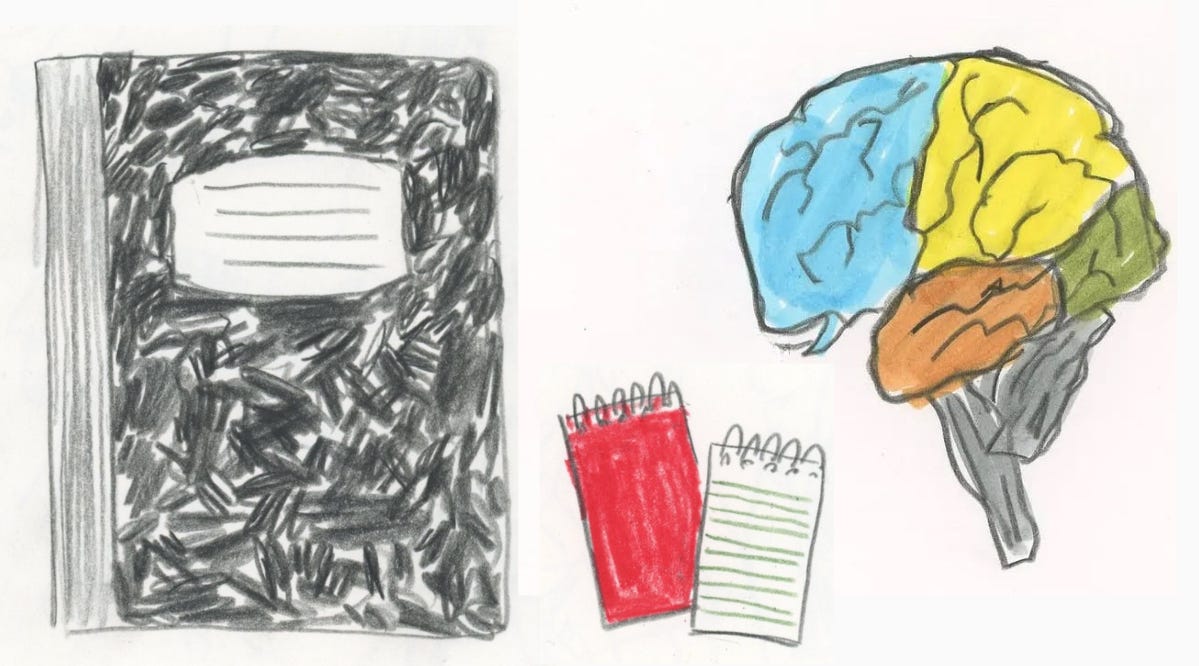
When I was a kid, there was this running joke in our house about my mother’s reading habits. She went through stacks of what we called “books with shiny covers”, which meant murder mysteries and thrillers with flashy foil letters on the cover. But she could never remember if she’d read a book already or not. She was forever picking up a new thriller, getting a few chapters in, and realizing that she’d read it already.
Ten year-old me thought this was hilarious! How could you FORGET that you’d read a BOOK? I could tell you everything about A Wrinkle in Time, the entire Chronicles of Narnia, From the Mixed-Up Files of Mrs. Basil E. Frankweiler…how could anyone read a book like that and not remember that they’d read it?
But I’m not ten anymore, and…uh…now I get it.
It’s the same with movies. Documentary series. Museum exhibits. Lectures. Plays. They just have a way of disappearing.
I do it, I enjoy it, I move on, it fades away. Aren’t these things supposed to be making me smarter, better read, more interesting? Isn’t that the whole point of culture?
What drives me crazy is that I have opinions about these things at the time! I see a movie, I have some thoughts. I go to a museum, I get an idea. I read a book, and that connects me to another book, another idea, another place. But where do all those thoughts go? Because I write books for a living, I’m in the habit of writing down SOME good ideas and interesting discoveries. But I’m probably catching ten or twenty percent of that stuff. What happens to the rest of it?
I’m not really interested in the question of why this happens. There are a few obvious answers, but they’re not important. What I want to know is: what’s the alternative?
A second brain
That’s the alternative. A book where you write all that good stuff down.1
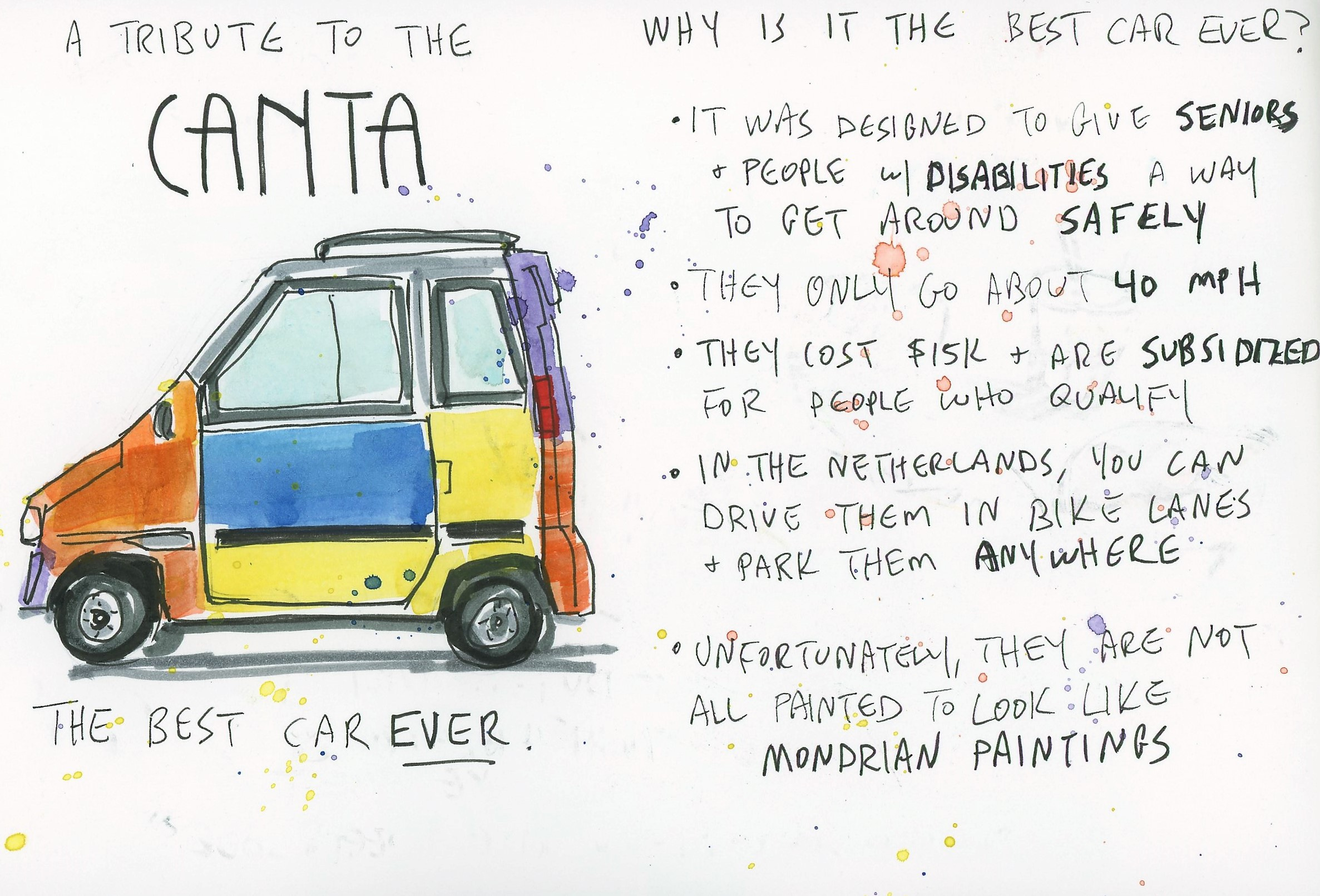
This is a follow-up on last week’s post about githerments, your own personal odd assortment of little ideas, minor interests, running jokes, low-key obsessions, trivialities, and areas of sub-expertise that you carry around with you, perhaps without even realizing it.
That idea seemed to strike a chord with a lot of you. Several people told me that they immediately started writing, journaling, or sketching about those things, and that it gave them a way to put more of themselves into their work. I particularly loved this, from Tina Koyama:
Yesterday for the first time ever, I cracked open an egg that had two yolks! I snapped a photo to show a friend. When I poached it, the yolks didn’t stay in the center like usual, and the whites made a weird shape around the twin yolks. But both yolks were perfectly poached. Anyway, I snapped a photo of that, too. Today I sketched from both photos and also noted other observations, like the membrane was super rubbery and hard to break. Yesterday, those photos would have been enough, but now I want to remember them better by sketching them! This is definitely giving me more material for my usual sketch journal! Fun!
See, that’s exactly the kind of thing I’m talking about! Just trying to capture what’s capturing your attention might give you a whole new reason to fill a journal or a sketchbook—but it also serves as a kind of second brain, a repository for all the interesting stuff that’s coming at you in the form of books, music, movies, double-yolked eggs, whatever!
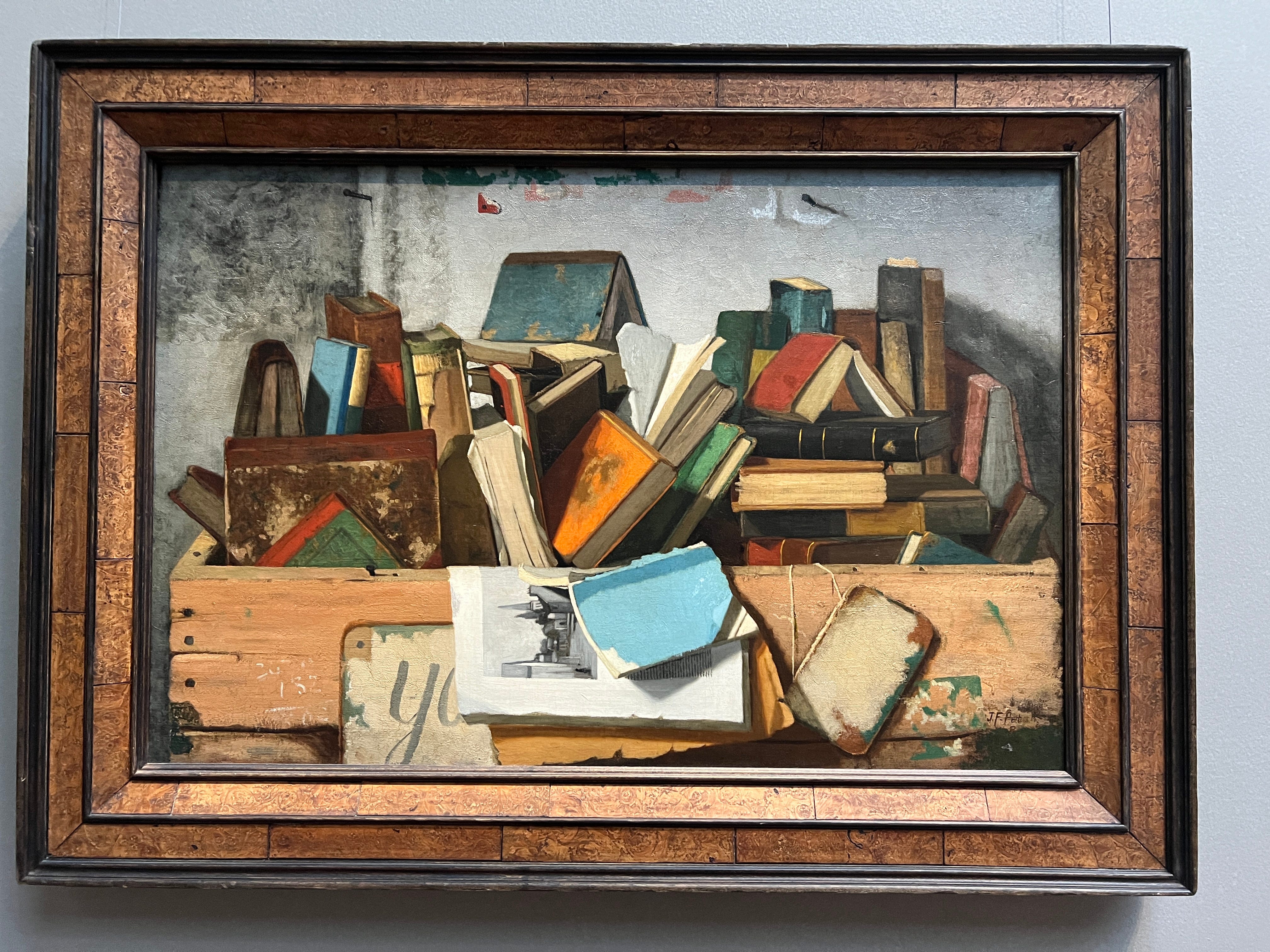
Why merely watch it all whiz by? Why not collect it—write it down or draw it—and let it become a of body of work that actually adds up to something?
And here’s what I’m starting to think: the something is YOU!
Just flipping through your second brain can be super entertaining and informative. You might think, “Oh yeah, I didn’t realize that movie was based on a book, and I meant to go read the book” or “wow, I seem to draw a lot of shoes, should I do some kind of shoe project with this?” (The answer is yes. Do your weird shoe project.)
But maybe it’s more than entertainment and record-keeping. Last month the New Yorker ran an essay by Joshua Rothman called “Can You Reclaim Your Mind?” He wrote about doing some digital de-cluttering and then said:
The bad distractions are mostly gone. The question is, Now what? At least in my case, taming technology hasn’t led directly to a reclaimed mind. I turned forty-six this year, and, apart from being underslept, I have no midlife complaints. I have a loving family, a rewarding job, fitness, energy, and more. But my mind feels a little . . . something. (Vague? Inflexible? Out of shape?) In my interior world, I’ve noticed a growing tendency toward stasis, which digital distractions may have helped me ignore.
He concludes it by saying:
What does it really mean to be in charge of your own mind? In many aspects of life, it’s easier to say what we don’t want than it is to say what we do. We don’t want to be screen-addled, apocalypse-minded nervous wrecks, incapable of reading for more than a quarter-hour at a time—fair enough. But who do we want to be? Maybe we just want to be people for whom that’s a live question. Reclaiming your mind might come down to reasserting your right to wonder what it’s for.
And maybe it’s about reclaiming your personality
Several of you reached out to me and had really profound things to say about what it even means to have a sense of ourselves, our identity, our personality. These philosophical and psychological questions are all well above my pay grade, but here’s the gist of what I heard from you all: how exactly do we go about figuring out what our personality is? What our identity is, our authentic self? Because it’s so easy to just see ourselves as an amalgamation of jitters and worries and half-solved problems and half-completed tasks.
But where’s the good stuff? The ideas, the interests, the out-there art installation at that one gallery, the twist ending to that novel, the funny song the guy on the street corner was singing, the joke your friend told you? All of it—all of the things you’re interested in—can come together to form the body of work that is you, if you’ll let it.
Did we used to be better at this? I saw Slacker recently for the first time since it came out. I was living in Austin at the time, and I think we all felt that the film captured something about the overeducated and underemployed college town vibe that was Austin in those days.
But what I realize, watching it now, thirty-five years later (good lord, how did that happen) is that it’s really a movie about people going around telling each other about whatever they’re into. The records they listen to, the books they read, the conspiracy theory they’re trying to spread.
We used to have all this stuff on our minds, and there was no app to post it to and no one to text it to. So we carried it around in the hopes that we could find someone to share it with. There was no offloading it to our phones or the internet and assuming everyone had already seen it, or could see it, some other time. You had to use some analog means—writing it down, making a cartoon, singing a song, telling a guy at a bus stop—to keep it alive.
So how do you start making note of what’s noteworthy?
Supporters are figuring out how to actually do this in practice—like, what does that notebook look like for you, how do you even keep track of what you want to capture in those pages, and how to maybe make it a launching pad into a bigger project.
These bonus posts go out on Mondays, you get access to an archive of over 100 tutorials on drawing and sketching, and going forward, we’ll be talking more about writing and idea-gathering as well.
I made a big chunk of this past Monday’s post free so you could preview it:
115. This Journal Is Authentically Yours

Wow so this post about gathering your githerments really struck a chord. Thanks, everybody, for your good comments and ideas.
Join us! It’s truly an inspiring group of people, and in a few weeks I’m going to be sharing some of the interesting projects they’re launching based on the idea of githerments and the self-appointed artist residency.
The Bit at the End
Find my books at your local bookstore, or order right here, and support independent bookstores with your purchase.
Did you know I have a reader survey? It’s a fun set of questions. You might enjoy it!I
Come find me on Instagram, or see paintings for sale- Right here
Order signed copies of some of my books from my husband’s bookstore, or order my books and many books I love at Bookshop.org
Take one of my online writing or art classes here
Leave a comment! I love to hear from you.
Been keeping a journal for 61 years. I guess that's my "second brain." But your githerments post also inspired me to start sketching my favorite things in my sketchbook!
I was inspired to do this, starting at the end of 2023, from reading Roland Allen's The Notebook: A History of Thinking on Paper. I've been calling mine a commonplace book - which I think is only roughly correct, since I include more than quotes in it, but it is organized with an index up front. I'm just wrapping up book #3 and I've been perusing the previous ones before launching journal #4. It's really satisfying to see what my brain was obsessed with at certain points in time - what has been abandoned since then, what has grown into new or different obsessions - and how these have shaped who I am now. I love your idea of githerments (my notebooks are slowly becoming more personal so this fits nicely) and also becoming the artist in residence of somewhere. At very least I am the artist in residence of my commonplace book.
Thank you for all the thoughtful inspiration!